SERVICES
Missing Child
- Home is where every child belongs. Home represents a safe, protective, caring and growth generating environment; a web of relationships that foster the full blossoming of human potentialities and all the physical supports and facilities that nature...provides.
- To an unaccompanied, out of home child, this foundation for her/his growth is missing. To those among them, who have a biological home of their own, restoration back home is meaningful only if that home provides for a safe and caring environment, where every relationship is healthy, where all basic needs are provided for, then such restoration is the best option. An alternative home is acceptable when the best is not available; when s/he cannot be in her/his own home. Until every such child is given an alternate caring, follow-up system that provides for the basic essentials in life, where s/he enjoys the joy of varied healthy relationships, and s/he feels protected, safe and experiences the security of belonging, we cannot say that the child’s right to a home has been restored.
- It is this essential right that we are committed to provide for every alone and lonely child.A home can thus include the child’s own home, adopted homes, foster homes, alternate caring home settings, group homes, children’s homes, special homes etc. Or even the home the child establishes on her/his own in late adolescence or as a young woman/man.
- The home link philosophy aims to meet every such unaccompanied or potentially unaccompanied child, whether s/he be lost, abandoned, run away, orphaned, abducted, trafficked or rendered destitute, at the earliest moment of her/his separation or loneliness at locations where s/he lands and partners her/him in their struggles and follows them up until an alternate community/home environment is established.
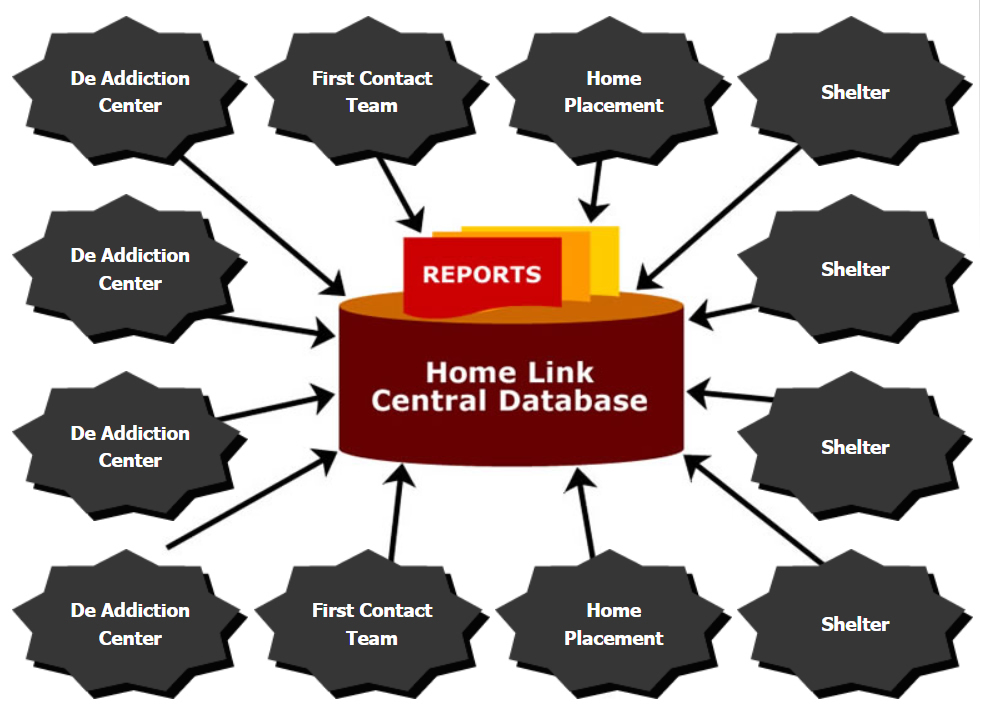
- The Home link network is the coming together of all such organizations, caring community groups and individuals who pool all their resources and link up all their services so as to facilitate a free flowing communication network that will ensure that every child has a home environment to grow in.
- This task demands that this network functions to prevent trafficking, rescue children from the clutches of every enslavement, heal traumas, addictions, hurts and denials; to fight exclusion, exploitation and discrimination; to challenge systems and structures that are detrimental to a child’s growth or cause harm. Essentially it requires the presence of healthy and caring persons in each of the locations where such children land up alone, bewildered and lost, accompanying her/him until s/he feels restored to a safe home environment.
- This is an information and documentation Support System for Youth Centres, taking care of the Young at Risk. Through specially designed software the documentation Centre uses this programm to create a link with other Salesian and other NGOs all over India in order to provide a flexible solution to document the organizational activities under the Street and Missing Child details, Home details, Alumni details. Through this software the Documentation Centre also uploads the details of children who are missing (Missing Child Search) to facilitate and stimulate the various linked organizations to seek out and try to find the concerned missing children within a short span of time.
Missing Child Search
- Many children reported to be missing remain untraced as there are no effective strategies designed so far at the National Level. Though some independent efforts have been tried by law enforcing agencies and social welfare institutions there is still a lacuna of organizing and interlinking efforts to trace these missing children. To identify these missing children, a concerted multi-pronged effort is required.
- Many children go missing when they come away from their family on their own because of an abusive family atmosphere or run away from home due to peer influence. Some children get lost when they are not able to trace out their parents. Many missing children are reported to be trafficked and thereafter subjected to different types of exploitation. Many of them get into the clutches of commercial sex brokers and are employed as laborers and sex workers. When children when they become victims of drugs or any other bad habits some of them prefer to remain on the streets.
- If the children are rescued by the law enforcement agencies they are kept at rescue homes or sent to observation homes. When the NGO comes in contact with the children they are provided temporary accommodation at their transitory homes. Prolonged stay on the streets and in the institutions restricts their freedom of growth and forces them to face many hazards. The sooner the children can be linked with their parents the better it will help them to grow in a proper atmosphere. But for those who lived longer on the streets and have lost roots with their family, it requires a systematic effort to trace these children. Meanwhile many parents also report about the missing children to their local police stations, in news papers, the Child Line, to institutions which receive complaints. Many a time the complaints remain with the police or the NGOs as they have no system to search for the missing child. Even if the child is found somewhere and if the child is back in the family the complaint still remains with the police station or NGOs as the parents do not give further information about the child. Therefore, most of the data that remains in the police stations or NGOs is often incorrect or unsatisfactory.
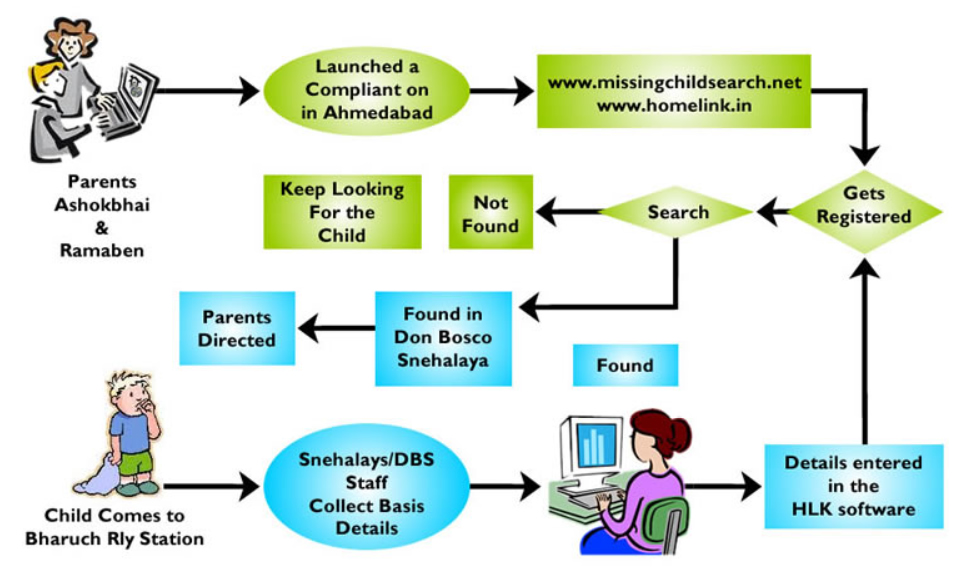
- Missing Child Search (MCS) is a website on which details of street and / or missing children are posted and request forwarded to linked and like-minded NGOs. This is a tool which the Documentation Centre uses to try to protect these street and missing children from the obvious abuses that they might be exposed to. This is done in close collaboration with the nearest Young at Risk (YaR) Organisation. All users can register and view the missing child details, news, search details and post their feedback.